
Osceola County Criminal Court Cases
Osceola County criminal court cases are filed in the Iowa District Court for Judicial District 3. Iowa uses a unified court system, so the county does not divide criminal records among separate Texas-style district, county, and municipal criminal courts. Felony and indictable misdemeanor matters remain District Court cases. Simple misdemeanors, traffic matters, and ordinance cases can appear under associate or magistrate case types within that same unified structure.
The Osceola County Clerk of District Court is the official local custodian. Its ground-floor counter is at 300 7th Street, Sibley, IA 51249, open weekdays from 8:00 a.m. to 4:30 p.m. Call 712-754-3595 for public documents that are not linked remotely, pre-1998 files, certified-copy questions, or a possible docket error. No local copy or certification price was published, so ask before ordering.
Who Files Osceola Criminal Cases
The Osceola County Attorney files and prosecutes Iowa-law and county-ordinance criminal matters, as well as juvenile cases. The office is in the same courthouse and can be reached at 712-754-4604 during general weekday hours. It does not represent private people, prepare their filings, or serve as the custodian for every county record. Once a complaint, information, or other charging document is filed, the Clerk maintains it as part of the case file.
This boundary matters when an arrest label and the court charge differ. The jail records the basis for custody. Prosecutor review may produce a different filed count, and the court later records the plea, ruling, disposition, and sentence. For the original incident or booking record, use the Sheriff. For the filed charge and outcome, use the Clerk and Iowa Courts Online.
The Osceola County Attorney’s official page confirms the local prosecutor’s role and courthouse location.
Searching Osceola County Case Records
Iowa Courts Online is the official statewide electronic docket gateway. Basic public docket access is free and requires no registration. It covers all public trial cases after 1998 and some earlier electronic records. New cases generally take one business day to appear, while tickets may take up to 14 days. Updates are described as real time after a case is indexed.
- Open Trial Case Search and choose the search mode that matches the identifiers available.
- Search by party name, exact date of birth, Case ID, or citation number as the selected mode allows.
- Choose Osceola for a Case ID search and narrow with the correct case type.
- Open the blue Case ID, then read charges, events, disposition, bonds, and money in their own panels.
- Contact the Clerk for the official document, a certified copy, an older file, or material not linked online.
Use the fewest reliable identifiers first. If a search fails, remove spaces, distinguish zero from the letter O, try fewer name letters, or check a former name. Scanned data can place first and last names in the wrong fields.
| Field Label | Type | Required | Official Notes |
|---|---|---|---|
| Last/Firm | Text | Yes for name search | Minimum two characters; % wildcard supported |
| First Name | Text | No in ordinary name search | Do not add a period after an initial |
| Exact DOB | Date | Yes in DOB mode | DOB, last, and first are all required |
| County | Dropdown | Yes in Case ID mode | Select Osceola |
| Case Type | Dropdown | Yes in Case ID mode | Includes FE, AG, SR, SM, OW, CR, and SW |
| Case ID | Text | Mode dependent | Up to 17 characters; capitals required |
| Citation Number | Text | Yes in citation mode | Use when the exact citation is known |
Osceola Court Search Timing
A missing Osceola County criminal court case may be too new, too old, confidential, or not yet electronic. A newly filed criminal matter typically needs one business day to reach the public portal. A ticket can require 14 days. Those published intervals explain why a Sheriff custody entry might appear before a matching court result.
Pre-1998 Osceola files begin with the Clerk. Some older cases exist electronically, but coverage is not complete. Juvenile and other confidential files do not appear publicly. An empty result therefore does not prove that no court contact occurred. Check spelling and former names, allow the ordinary indexing interval, and then call the Clerk with the name, likely date, and any known case number.
Note: A jail charge records the custody basis; only the filed court charge and disposition show how prosecution proceeded.
Inside an Osceola County Case File
A criminal case file is organized around the court action, not the arrest narrative. The portal summary identifies the Case ID, case type, creation date, indexed judge, and title. Party panels list names, roles, status, and lawyers. Charge and disposition panels connect each filed count to the defendant and outcome. Filing entries form the timeline.
| Case Number & Court | Case ID, case type, creation date, indexed judge, and title. |
|---|---|
| Charging Document | Complaint, information, indictment, or another filed accusation where public. |
| Docket Entries | Event, filed date, filing party, comments, update date, and status. |
| Parties & Lawyers | Name, role, status, and counsel associated with the case. |
| Disposition & Judgment | Outcome for each charge, including dismissal, acquittal, conviction, or deferred result. |
| Sentence & Money | Fine, surcharge, restitution, costs, amount paid or due, and court-imposed conditions. |
| Bond | Set and posted amount, date, poster or agent, type, disposition, county, and service data. |
Not every document image or detail is guaranteed remotely. Some schedules, judgment or lien indexes, exhibit lists, bonds, and service returns require a courthouse terminal or subscription. The portal itself warns that its display is not the official court record.
Osceola Courthouse Terminal Access
The Clerk’s public-access terminal closes the gap between a basic remote docket and courthouse-available electronic material. Public electronic documents that are not linked for home viewing can be inspected there. The counter also handles non-electronic files and questions about certified records. This is the correct fallback when a docket entry exists but the filing itself is unavailable online.
The Iowa Courts Online gateway is the source for the assigned court-search image.
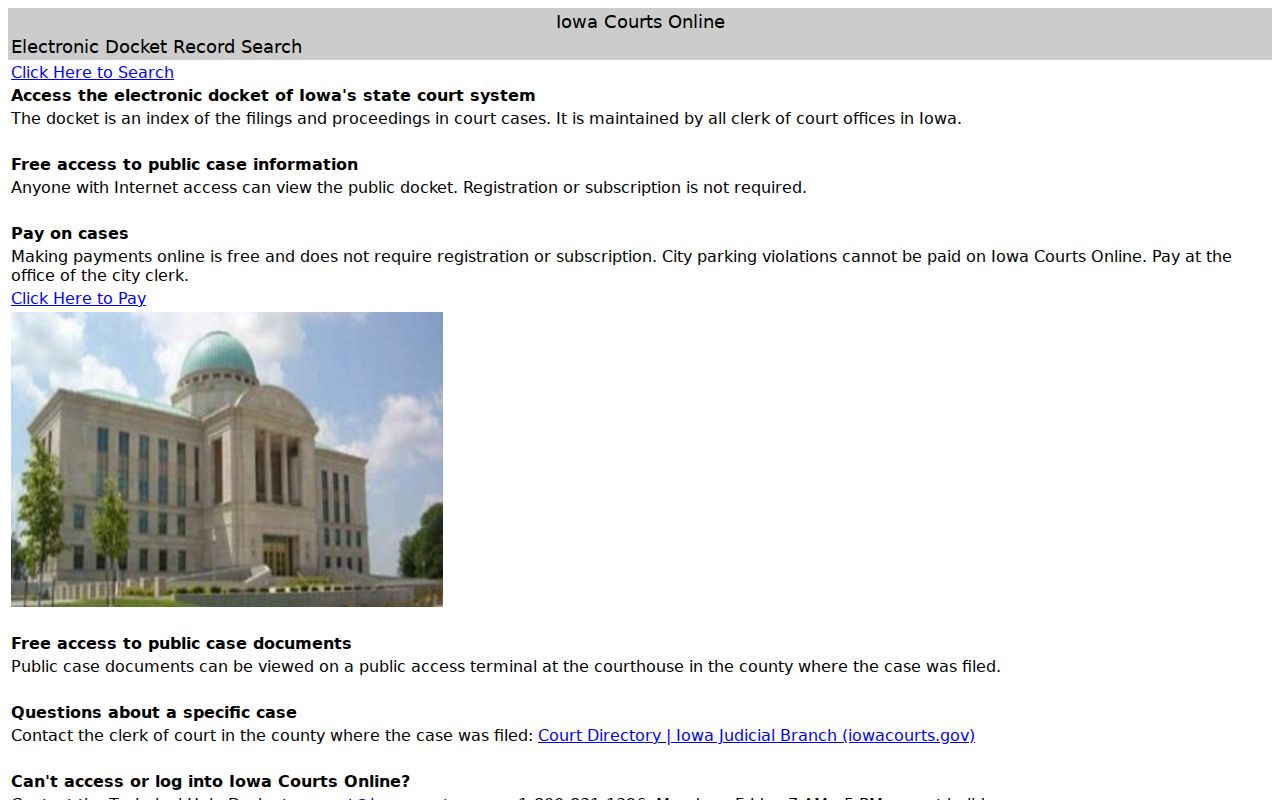
The captured interface represents the statewide starting point, while the ground-floor Osceola County clerk counter remains the route to the official local court file.
How a Criminal Case Moves
A law-enforcement arrest can precede the court case, but the court file begins when a charging document is filed. Arraignment is the stage at which a formal plea is entered. Pretrial events can include motions, discovery disputes, scheduling, or bond review. A plea agreement may resolve the matter, or the case can proceed to trial. The court then enters a disposition and, following a conviction when required, a sentence.
Case flow: Charges Filed › Arraignment › Pretrial › Plea or Trial › Disposition › Sentencing
Read the docket in date order, but do not assume every event is a final ruling. A filed charge is an accusation. A plea is the defendant’s formal response. The disposition states the outcome. The sentence records the consequence after a guilt judgment or other qualifying resolution.
Osceola Criminal Case ID Codes
Case-type codes help identify which docket appeared in a search. FE means felony. AG, SR, and SM mean aggravated, serious, and simple misdemeanor. OW identifies operating while intoxicated. CR is a criminal category, AR is criminal appeal, SW is search warrant, and PC is postconviction relief. NT and ST are nonscheduled and scheduled traffic.
- Disposition
- The outcome recorded for a charge or case.
- Deferred judgment
- A judgment withheld while court conditions are completed.
- Recognizance
- Release on a promise to appear, subject to conditions.
- Surety bond
- A third party’s guarantee that secures the required appearance.
- Concurrent sentence
- Two or more sentences that run at the same time.
These labels classify records and court actions. They do not establish guilt by themselves. Read the specific charge description and its matching disposition before drawing a conclusion.
One Osceola Criminal Court Route
Sibley, Ocheyedan, and Ashton do not have separate verified municipal criminal-court portals. City and county-ordinance matters that become filed cases use the unified Osceola District Court route. This is why selecting Osceola in Iowa Courts Online works for a case tied to any of those communities, even when a city clerk keeps the original ordinance or administrative record.
Use the city clerk for city minutes, ordinances, and similar municipal documents. Use the Sheriff for countywide incident and arrest records. Use the Clerk for the criminal docket and filed documents. If the event began with an arrest, the Osceola County arrest lookup explains how booking, custody, and court timestamps differ.
Note: County Sheriff statistics cannot be divided into reliable city crime rates without an official city-specific series.
Case Record Access & Restrictions
Iowa Code chapter 22 grants access to public records but does not override specific confidentiality. Iowa Court Rules chapter 16 governs electronic filing and access. Juvenile matters, protected victim data, personal identifiers, active restrictions, and qualifying expunged records may be absent or redacted. Iowa Code chapter 901C makes qualifying expunged court records confidential and directs removal of specified criminal-history data after clerk notice.
When part of a record is protected, ask whether a segregable public portion can be released. When no case appears, distinguish a confidential case from a missing or delayed case by checking the identifiers and coverage before contacting the Clerk. A financial balance also does not confirm a current warrant. Osceola County publishes no active-warrant database, so current warrant questions require the Sheriff and the underlying court case.
Official-record rule: Iowa Courts Online is a public index. Confirm any record that matters with the Osceola County Clerk of District Court and the originating filing.