
Checking Criminal History in Osceola County
No single Osceola County criminal record product covers every stage. Begin with Iowa Courts Online when the goal is to follow a filed case. Use the Sheriff’s weekly roster for a recent custody snapshot, or contact the Sheriff for an incident, arrest, booking, warrant, 911, or video record. Choose an Iowa DCI check when the question concerns the statewide repository. Iowa Offender Search is the separate route for state prison or community-supervision data.
Names can vary across sources. Gather the full current name, former names, exact date of birth when lawfully available, approximate event date, location, and any known case or report number. Search broad enough to catch a spelling variation, then compare the record’s court, event date, and case type before treating it as a match.
- Search Iowa Courts Online with Osceola selected for filed criminal cases and dispositions.
- Review the Sheriff’s dated weekly roster or call the jail for recent local custody.
- Ask the record-creating office for the public incident, booking, or court document.
- Order a DCI check for fingerprint-supported Iowa repository history.
- Resolve missing, older, certified, or restricted material with the Clerk or proper agency.
Three Osceola Criminal Record Custodians
Osceola County criminal history is compact in geography but split by custodian. The Clerk of District Court and County Attorney work at 300 7th Street in Sibley. The Clerk keeps court dockets and filed documents. The County Attorney prosecutes Iowa-law and county-ordinance cases, but does not represent private people or serve as a general records warehouse. One block away, the Sheriff, dispatch, and jail operate at 309 6th Street.
That split determines where a request belongs. A Sheriff report does not become a court file merely because charges may follow. A docket does not contain every investigative detail. DCI later assembles qualifying fingerprint and disposition data into a repository record. Send a focused request to the office that created the record.
Clerk of District Court
300 7th St., Sibley, IA 51249
712-754-3595
Weekdays 8:00 a.m.–4:30 p.m.
Osceola County Sheriff
309 6th St., Sibley, IA 51249
712-754-2556
Call for current records access details.
Osceola County Attorney
300 7th St., Sibley, IA 51249
712-754-4604
Weekdays 8:00 a.m.–4:30 p.m.
Iowa Official Background Checks
The Iowa Division of Criminal Investigation offers Iowa Record Check Online plus mail, fax, email, and walk-in channels. The request is name based even though the state repository depends on fingerprint-supported reporting. First name, last name, and exact date of birth are required. Each last name costs $15, and both Request and Billing forms must be complete.
A signed subject release affects disclosure. Without it, DCI excludes completed deferred judgments and arrests more than 18 months old that lack a final disposition. Online, mail, fax, and email processing is described in ranges from one to five business days, based on staffing and volume. DCI does not take record-check requests by telephone. For self-review of FBI identity history, the FBI offers its own subject-only fingerprint process for $18. No official public fingerprint-card schedule or fee was found in Osceola County, so confirm local card rolling with the Sheriff first.
The manifest image captured from the DCI criminal-history check page shows the state route used for an official Iowa repository request.
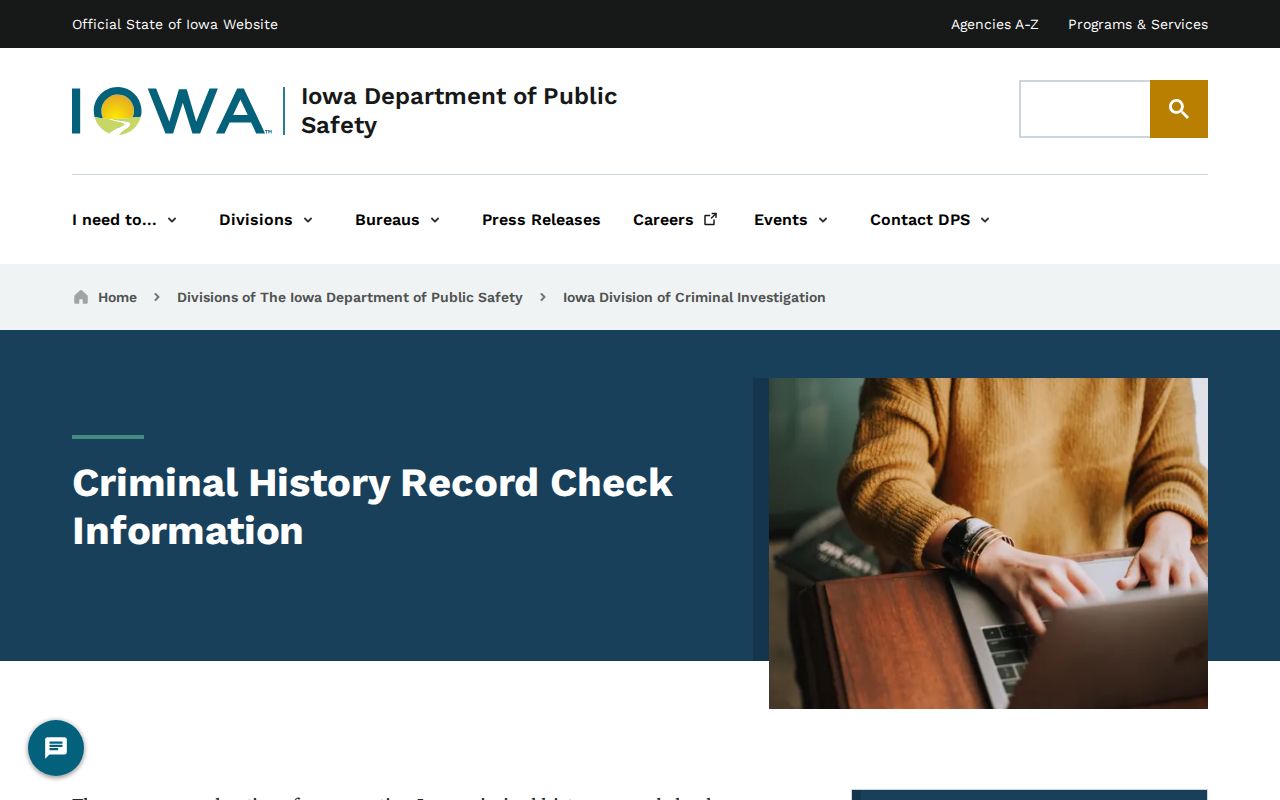
It is a submitted request-and-return service, not an instant results screen or a substitute for the original Osceola County court file.
Osceola Criminal Custody Snapshots
The Sheriff’s Current Inmates page is a dated PDF index, not a searchable live database. Its weekly roster displays only Arrested, Release, Charge(s), and Bond. It does not show a mugshot, booking number, birth date, physical description, arresting agency, court date, warrant number, or housing unit. A person may enter or leave custody after the PDF was posted.
For present status, call the jail at 712-754-2556. IowaVINE provides anonymous phone or email custody-change notices at 888-742-8463. After a transfer to state custody or supervision, use Iowa Offender Search instead. The Osceola County arrest lookup explains these channels and their different timestamps in greater depth.
The custody campus is also changing. Official bid materials describe a 7,182-square-foot public-safety remodel and a new 14-bed jail addition beside an existing jail described as holding up to 13 people. Bid alternatives allow eventual growth to 36 beds. An April 2026 occupancy date appeared in planning documents, but the county still called the work in progress during 2026. Treat the project as active construction, not a completed capacity increase. Board minutes also say the courthouse south entrance remained locked for security during the remodel, so call before relying on an old entry route.
Note: A weekly custody entry records a booking basis, not a finding of guilt or a final filed charge.
Criminal Record Types
Each Osceola County criminal record captures one step in a longer process. The creator, purpose, and update cycle vary. Treat a local report, a booking line, a court docket, and a DCI response as related records rather than interchangeable products.
- Incident and arrest reports describe an allegation and law-enforcement action kept by the arresting agency.
- Booking records document local custody, release, charge labels, and bond at the county jail.
- Criminal court files hold filed charges, events, pleas, motions, disposition, financial entries, and sentence.
- DCI repository history assembles fingerprint-supported Iowa arrest cycles and reported outcomes under dissemination law.
- Corrections and registry records address state custody, supervision, or a legal registration duty.
Warrants require special care. Osceola County publishes no verified active-warrant search or list. The safe fallback is to call the Sheriff, check the related court case, and ask the Clerk about public case status. An empty website search does not establish that no warrant exists.
How Osceola Criminal Records Flow
A local agency first creates an incident or arrest report. When someone enters the Osceola County Jail, the Sheriff creates a booking and custody file. The County Attorney may then file a complaint, information, or other charging paper. Once filed, the Clerk maintains the docket, public documents, financial entries, and disposition. Fingerprints and later court reporting may reach DCI and become part of an Iowa criminal-history cycle.
Record flow: Incident or arrest › Booking › Prosecutor filing decision › District Court docket › Disposition › DCI and corrections updates
Breaks can occur at several points. DCI warns that an arrest does not enter the repository unless fingerprints were taken and submitted. A name mismatch or unreported disposition may also cause a gap. Compare the local court and arresting-agency records before disputing a DCI response.
Inside an Osceola County Criminal Record
The fields depend on the record type. A court case centers on the Case ID, parties, charges, filings, bonds, money, and outcome. A DCI rap sheet organizes identity and fingerprint-supported arrest cycles. The county’s public booking roster is much narrower. Reading the field labels in context prevents a charge line from being mistaken for a conviction.
| Name & Identifiers | Names, aliases, date of birth, and state or FBI identifiers where the record lawfully includes them. |
|---|---|
| Arrest / Booking Data | Agency event, arrest date, release, charge labels, and bond, depending on the source. |
| Charges & Statutes | Alleged offense text and Iowa or city code references, which can change at filing. |
| Disposition | Dismissal, acquittal, conviction, deferred judgment, or another final result. |
| Sentence | Custody, probation, fines, restitution, surcharge, and related court conditions. |
| Custody / Supervision | County release, state prison status, probation, or parole in the proper system. |
Reading Osceola Criminal Case Codes
Iowa Courts Online uses short case-type codes. FE means felony, while AG, SR, and SM mean aggravated, serious, and simple misdemeanor. OW covers operating while intoxicated. NT and ST are nonscheduled and scheduled traffic. SW marks a search-warrant case type, although sealed, unexecuted, or confidential material may not appear.
- Disposition
- The recorded outcome of a charge or case.
- Deferred judgment
- A judgment withheld while the person completes court conditions.
- Recognizance
- Release based on a promise and any set conditions rather than a cash deposit.
- Restitution
- Court-ordered payment for a loss tied to the offense.
- Expungement
- An Iowa statutory process that makes qualifying court material confidential and removes specified DCI data.
Codes classify the docket. They do not prove guilt. Open the charge and disposition panels separately, and contact the Clerk when the online label is unclear.
Public Access Laws in Iowa
The Iowa Open Records Law starts with the actual custodian and permits examination or copying of public records subject to lawful limits and reasonable actual costs. Iowa criminal-history and court rules add source-specific boundaries. An office need not create a new analysis or answer a broad research question. A precise request for an existing record works better.
Key statutes and rules:
Iowa Code §§22.2 and 22.7 grant public access while protecting listed confidential material.
Iowa Code §§692.2 and 692.18 govern DCI dissemination, public criminal-history data, and fees.
Iowa Court Rules chapter 16 controls electronic filing and court-record access.
Iowa Code chapter 901C makes qualifying expunged records confidential and directs specified state removal.
Iowa Code §904.602 identifies public fields in state corrections records.
Juvenile data, active-investigation material, victim safety information, medical facts, personal identifiers, and expunged matter may be withheld or redacted. Ask for the segregable public portion when only part of a file is protected.
Osceola Criminal Record Request Costs
Osceola County’s published Chapter 22 policy provides a local cost benchmark but is not a request form. Contact the agency holding the record and ask for an estimate, accepted delivery method, and any identity or prepayment condition. The Sheriff publishes no separate report-copy price, named Records Division, online portal, or standard turnaround.
| County cost item | Published amount |
|---|---|
| Secretarial time | $18 per hour |
| Attorney time or confidential/public sorting | $40 per hour |
| Paper copies | $0.50 per page in addition |
| Estimate above $10 | Prepayment required |
| Vendor or technical help | Prepaid at outside rate |
| Mailing | Actual cost |
A focused request can reduce search and sorting time. Include the event date, time and place, involved party, report or case number if known, exact record sought, desired format, and contact details. These are practical narrowing points, not a published mandatory form.
If protected information is mixed with public facts, ask whether the custodian can provide a redacted or segregable portion. The policy does not make the County Attorney a central intake office for all Osceola County criminal records. Sheriff-created records go to the Sheriff, court filings go to the Clerk, DCI history goes to DCI, and state correctional material goes to Iowa DOC.
Sealed, Expunged, and Restricted Records
Iowa generally treats juvenile material as confidential under Iowa Code §232.147. A discharged deferred judgment can remain in DCI as nonconviction information and is released to a non-law-enforcement requester only with signed authorization. Protected identifiers, victim information, and other confidential data may also be redacted from an otherwise public Osceola County criminal record.
Iowa Code chapter 901C supplies several limited expungement routes. A qualifying acquittal or dismissal may support an application in the original case. An eligible misdemeanor process requires more than eight years since conviction, no pending charges, the allowed prior deferred-judgment history, and full payment of court obligations. It is generally limited to once in a lifetime, with detailed offense exclusions.
Find the case in Courts Online, confirm disposition and balances with the Clerk, read the current statute, file in the original criminal case, and verify that any order reached both the Clerk and DCI. Osceola County publishes no local clinic, petition packet, filing fee, or automatic Clean Slate program.
Osceola Criminal Supervision Records
Iowa DOC Third District provides probation and parole supervision for Osceola County. The nearby Sheldon Parole and Probation Office is at 720 Western Avenue in Sheldon and can be reached at 712-324-5384. The Iowa Board of Parole makes release decisions, while Third District staff supervise parole locally and also support court-ordered community supervision.
The Third District page supplied the source for the local corrections image below and describes services such as cognitive education, pretrial sentence supervision, treatment, aftercare, and special-sentence supervision.
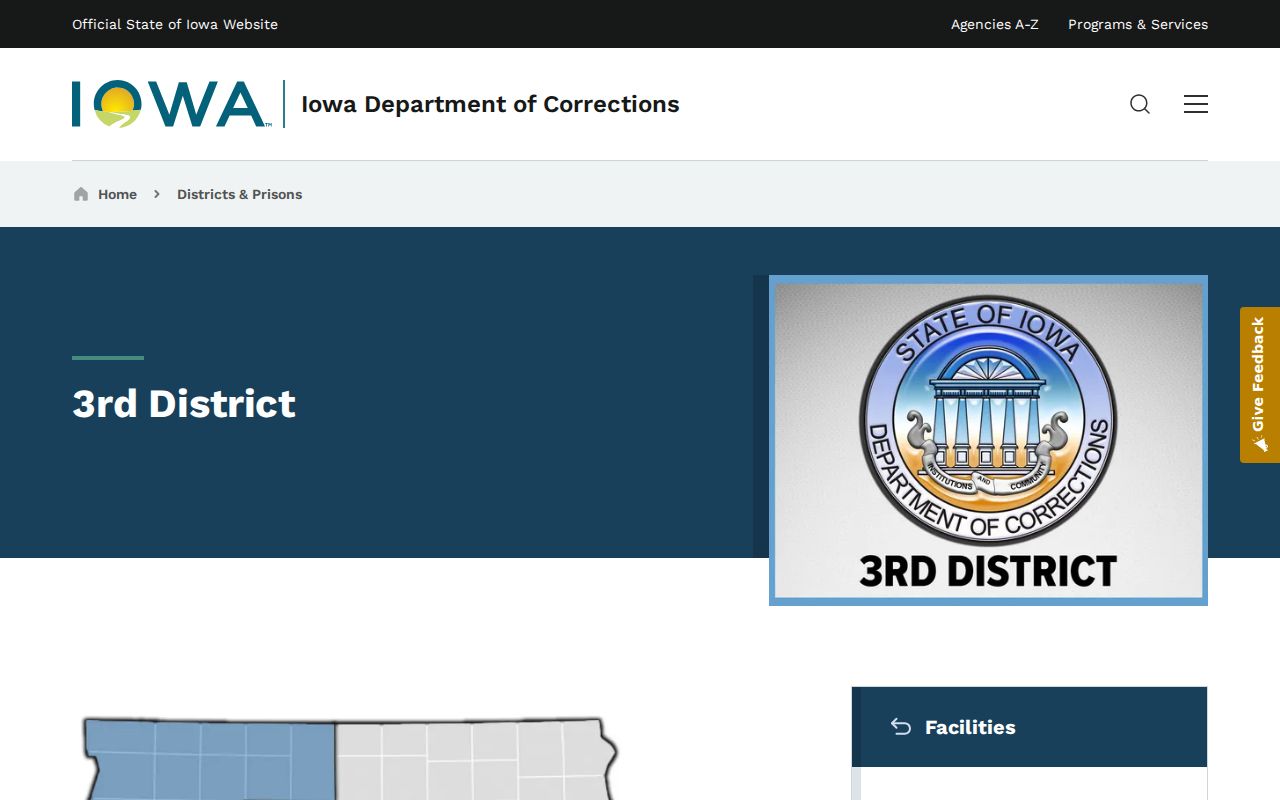
The image connects Osceola County criminal records to the state district that maintains the supervision layer after a court sentence.
The Iowa Offender Search entry page is the official route documented for public state-custody and supervision searches.
County jail status remains separate. Use the Sheriff for local custody and the Clerk for the sentence that created probation or another court condition.
Osceola Criminal Charges at Filing
A booking charge reflects the basis for custody at intake. It can differ from the count later filed after prosecutor review. The Osceola County Attorney prosecutes criminal and juvenile matters under Iowa law, along with county-ordinance cases, and the Clerk keeps the charging paper once filed. A release from jail also does not mean the court case ended.
The official Osceola County Attorney page is the source for the office image used here.
Read the filed charge and disposition in the court docket, rather than treating an early booking label or selected Sheriff press release as the final case record.
Osceola County Criminal Records by City
The 2020 Census ranks Sibley, Ocheyedan, and Ashton as Osceola County’s three largest incorporated cities. Verified law-enforcement access is centralized through the county Sheriff, and filed cases use the unified Iowa District Court route. City clerks hold city administrative and ordinance records, not Sheriff reports or District Court files. Each city guide distinguishes those local counters.
Sibley Criminal Records
Population 2,860 · County record offices are in the county seat.
Ocheyedan Criminal Records
Population 439 · City Hall and county custodians keep distinct records.
Ashton Criminal Records
Population 436 · Sheriff and District Court provide the verified justice route.